


Critical temperature evaluation for steel column exposed to fire – Rankine – Merchant approach
1
Katedra Konstrukcji Mostowych, Metalowych i Drewnianych, Wydział Inżynierii Lądowej, Politechnika Krakowska, Poland
2
Wydział Inżynierii Lądowej, Katedra Technologii Informatycznych w Inżynierii, Politechnika Krakowska, Poland
Submission date: 2024-12-07
Final revision date: 2025-04-13
Acceptance date: 2025-04-29
Publication date: 2026-06-14
Corresponding author
Mariusz Maślak
Katedra Konstrukcji Mostowych, Metalowych i Drewnianych, Wydział Inżynierii Lądowej, Politechnika Krakowska, Warszawska 24, 31-155, Kraków, Poland
Katedra Konstrukcji Mostowych, Metalowych i Drewnianych, Wydział Inżynierii Lądowej, Politechnika Krakowska, Warszawska 24, 31-155, Kraków, Poland
Archives of Civil Engineering 2026;72(2):557-570
KEYWORDS
critical temperaturefire resistancefire exposureiterative procedureRankine – Merchant rulesteel column
TOPICS
ABSTRACT
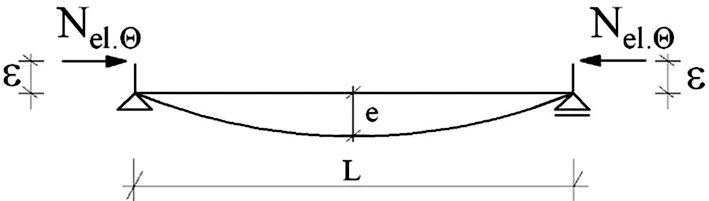
An alternative computational approach to the critical temperature specification for a steel column, related to the fire conditions and associated with loss of the capacity to safely resist the loads applied to it is presented and discussed in detail. The algorithm recommended by the authors has been derived from the empirical Rankine – Merchant rule, with parameters calibrated so as to obtain quantitative agreement with critical temperature estimates arrived at after application of the conventional code-based approach. It has been indicated, that this approach results in an iterative calculation. Knowledge of the critical temperature determined for given structural component or a substructure under assumed fire development scenario allows for identification of its fire resistance interpreted as the forecast time of reliable service when subjected to the influence of high temperature. Numerical example presented in this paper pertains to the column devoid of any restrictions in elongation, not fire protected and heated uniformly around the whole perimeter and along the whole length. To simplify the example it has been assumed, that at any given moment of fire steel temperature is constant in the column cross-section and increases with increasing temperature of surrounding fire plume. The approach proposed by the authors allows for verification, in both qualitative and quantitative terms, of the influences exerted by geometrical imperfections of various origins on the final critical temperature specifications, in particular those related to a potential eccentricity of load application point as well as those induced by the longitudinal axis of column deviating from straightness.
Share
RELATED ARTICLE
| eISSN: | 2300-3103 |
| ISSN: | 1230-2945 |

We process personal data collected when visiting the website. The function of obtaining information about users and their behavior is carried out by voluntarily entered information in forms and saving cookies in end devices. Data, including cookies, are used to provide services, improve the user experience and to analyze the traffic in accordance with the Privacy policy. Data are also collected and processed by Google Analytics tool (more).
You can change cookies settings in your browser. Restricted use of cookies in the browser configuration may affect some functionalities of the website.
You can change cookies settings in your browser. Restricted use of cookies in the browser configuration may affect some functionalities of the website.