


A case study of terrestrial laser scanning as a data source for 3D modeling for water flow analysis in a small hydropower plant
1
Faculty of Civil Engineering, Environmental and Geodetic Sciences, Koszalin University of Technology, Poland
2
Faculty of Geoengineering, University of Warmia and Mazury in Olsztyn, Poland
3
Faculty of Civil and Environmental Engineering, Gdańsk University of Technology, Poland
Submission date: 2025-09-24
Acceptance date: 2025-09-30
Publication date: 2026-09-25
Corresponding author
Piotr Kędziorski
Faculty of Civil Engineering, Environmental and Geodetic Sciences, Koszalin University of Technology, Śniadeckich 2, 75-453, Koszalin, Poland
Faculty of Civil Engineering, Environmental and Geodetic Sciences, Koszalin University of Technology, Śniadeckich 2, 75-453, Koszalin, Poland
Archives of Civil Engineering 2026;72(3):317-333
KEYWORDS
TOPICS
ABSTRACT
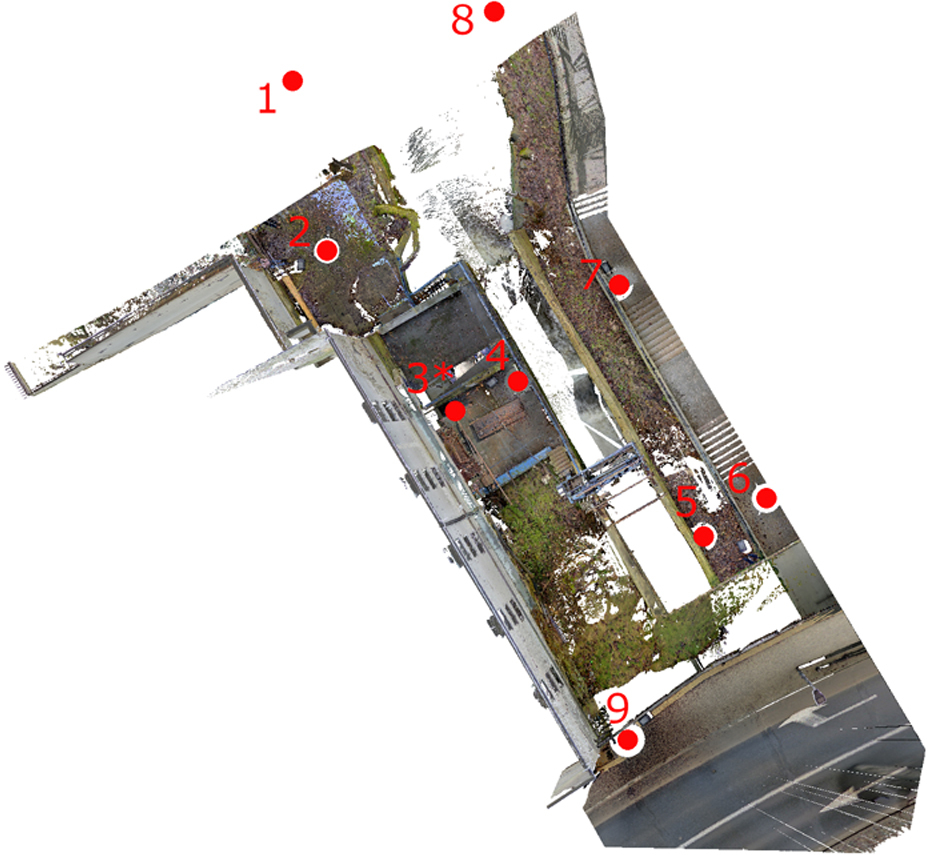
The article proposes a methodology for measuring and processing results, integrating data obtained from Terrestrial Laser Scanning (TLS) with Computational Fluid Dynamics (CFD) analyses, aimed at evaluating water flow conditions in a real-world Small Hydropower Plant (SHP) system. Based on TLS data, a detailed 3D model of the SHP (located in Koszalin, Poland) geometry was developed, which was used to conduct a series of numerical simulations in ANSYS Fluent. The analyses covered six water flow variants, including simulated scenarios accounting for different widths of potential dam leakages. The results confirmed that using TLS data as the basis for the geometric model enables the investigation of actual water flow in the hydropower system. The developed 3D SHP model achieved an accuracy of ±0.02 m relative to the acquired point cloud, and the analyses performed based on it allowed for the evaluation of water flow in the system. The study showed that, in the case of a sealed intake chamber, outlet number 2 handles the largest water mass, accounting for 39.2% of the total flow, while outlets number 1 and 3 account for 33.9% and 26.9%, respectively. The proposed use of TLS data for 3D modeling for water flow analyses in SHP systems highlights the significant potential of integrating TLS and CFD as a widely applicable engineering tool.
Share
RELATED ARTICLE
| eISSN: | 2300-3103 |
| ISSN: | 1230-2945 |

We process personal data collected when visiting the website. The function of obtaining information about users and their behavior is carried out by voluntarily entered information in forms and saving cookies in end devices. Data, including cookies, are used to provide services, improve the user experience and to analyze the traffic in accordance with the Privacy policy. Data are also collected and processed by Google Analytics tool (more).
You can change cookies settings in your browser. Restricted use of cookies in the browser configuration may affect some functionalities of the website.
You can change cookies settings in your browser. Restricted use of cookies in the browser configuration may affect some functionalities of the website.