


The impact of macroeconomic variables on the selected type of traffic crash: a study based on ARDL technique
1
Department of Civil and Infrastructure Engineering, Al-Zaytoonah University of Jordan, Jordan
Submission date: 2024-10-30
Final revision date: 2025-01-16
Acceptance date: 2025-01-28
Publication date: 2026-06-14
Corresponding author
Maen Qaseem Ghadi
Department of Civil and Infrastructure Engineering, Al-Zaytoonah University of Jordan, 11733, Amman, Jordan
Department of Civil and Infrastructure Engineering, Al-Zaytoonah University of Jordan, 11733, Amman, Jordan
Archives of Civil Engineering 2026;72(2):393-404
KEYWORDS
TOPICS
ABSTRACT
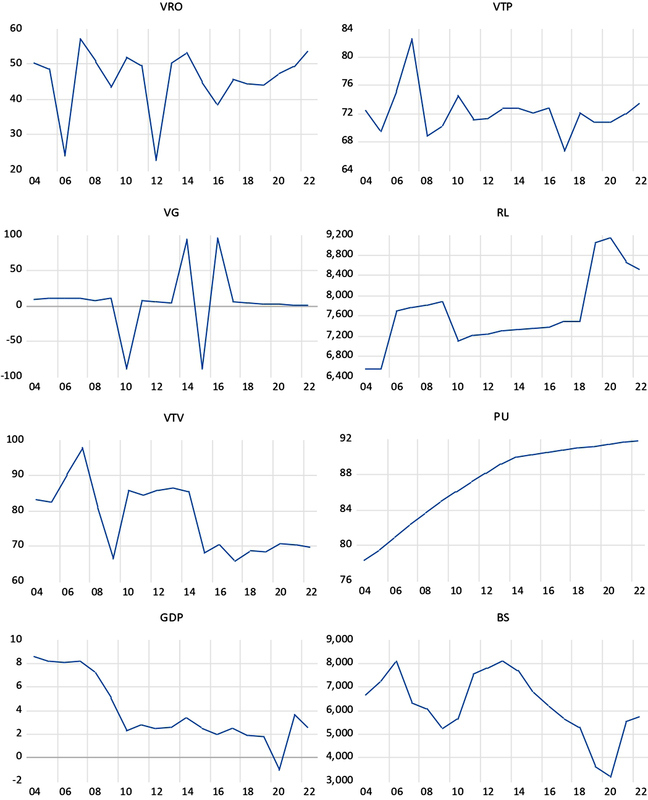
Urban Jordan has witnessed substantial traffic growth in recent years. This study examines the long-term and dynamic nexus between crash rates in urban Jordan cities and macroeconomic explanatory variables. Three types of crashes have been studied including, vehicle rollover, vehicle-pedestrian crashes, and vehicle-vehicle crashes against the following explanatory variables; the proportion of the population living in urban areas, GDP growth rate, the total length of road networks, vehicle number growth rate, and spaces of the newly added building. Accordingly, a case study method has been used, covering the timeframe from 2004 to 2022, by employing the autoregressive distributed lag (ARDL) technique. The ARDL estimates showed the presence of long-run cointegration between variables for all types of crashes. Furthermore, the ARDL estimates on the long- and short-run indicate a varying effect of the considered explanatory variables by crash type. The results indicate that the expansion of the urban population and GDP growth rate play a significant role in determining crash rate in urban cities. Moreover, this study urges decision-makers to monitor the impact of expected migration on traffic safety, whether from the countryside or neighbouring countries experiencing crises.
| eISSN: | 2300-3103 |
| ISSN: | 1230-2945 |

We process personal data collected when visiting the website. The function of obtaining information about users and their behavior is carried out by voluntarily entered information in forms and saving cookies in end devices. Data, including cookies, are used to provide services, improve the user experience and to analyze the traffic in accordance with the Privacy policy. Data are also collected and processed by Google Analytics tool (more).
You can change cookies settings in your browser. Restricted use of cookies in the browser configuration may affect some functionalities of the website.
You can change cookies settings in your browser. Restricted use of cookies in the browser configuration may affect some functionalities of the website.