


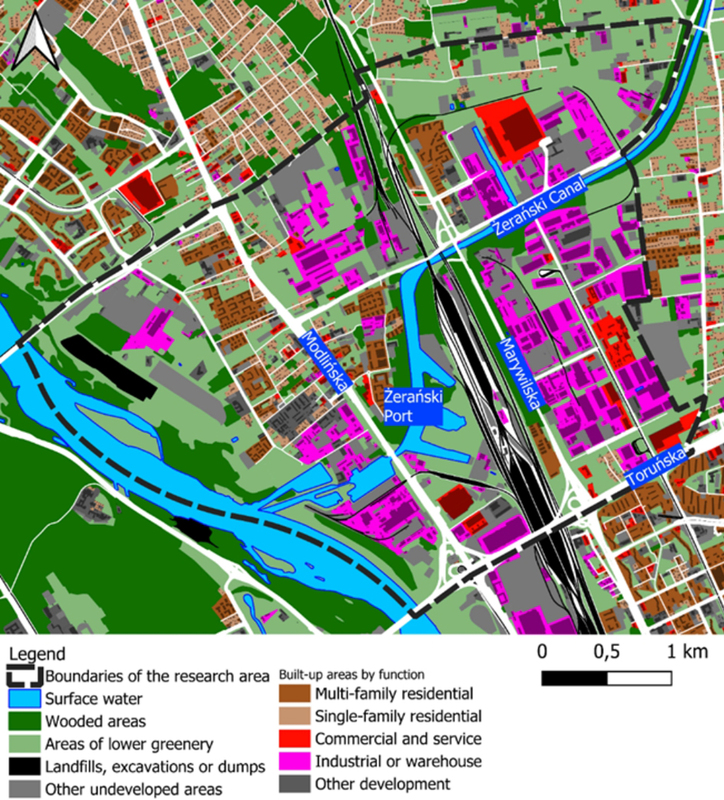
Revitalization possibilities of post-industrial and warehouse areas on the example of Warsaw's Żerań
1
Faculty of Geodesy and Cartography, Warsaw University of Technology, Poland
Submission date: 2025-02-17
Final revision date: 2025-06-25
Acceptance date: 2025-07-08
Publication date: 2025-12-01
Corresponding author
Łukasz Kuzak
Faculty of Geodesy and Cartography, Warsaw University of Technology, Plac Politechniki 1, 00-661, Warszawa, Poland
Faculty of Geodesy and Cartography, Warsaw University of Technology, Plac Politechniki 1, 00-661, Warszawa, Poland
Archives of Civil Engineering 2025;71(4):43-61
KEYWORDS
TOPICS
ABSTRACT
Suburbanization and urban sprawl, alongside the concept of creating compact cities, highlight the need to repurpose undeveloped, degraded spaces, such as post-industrial and warehouse areas. Revitalizing these spaces involves addressing the land's physical condition and improving the social and economic well-being of local communities.
In many European cities, the late 20th century saw industrial activity dominate. However, after 1989, political changes in Poland led to the relocation of industry from central districts to make room for modern residential and service developments. An example is Warsaw's Żerań, previously centred around industrial hubs. A key challenge in redeveloping such areas is addressing land contamination, reclaiming degraded post-industrial zones, and eventually revitalizing the space to introduce new functions.
Contamination often leaves these areas unused for years, but proper remediation can breathe new life into them. Furthermore, public spaces such as parks and squares in Żerań are often underused, but proper design following cleanup can foster social connections and contribute to a well-functioning urban environment.
Revitalizing degraded urban areas ensures rational use of available space, aligning it with desired functions. Identifying and addressing these areas can transform neglected industrial zones into thriving residential and service centres, attracting new residents and investors.
Share
RELATED ARTICLE
| eISSN: | 2300-3103 |
| ISSN: | 1230-2945 |

We process personal data collected when visiting the website. The function of obtaining information about users and their behavior is carried out by voluntarily entered information in forms and saving cookies in end devices. Data, including cookies, are used to provide services, improve the user experience and to analyze the traffic in accordance with the Privacy policy. Data are also collected and processed by Google Analytics tool (more).
You can change cookies settings in your browser. Restricted use of cookies in the browser configuration may affect some functionalities of the website.
You can change cookies settings in your browser. Restricted use of cookies in the browser configuration may affect some functionalities of the website.