


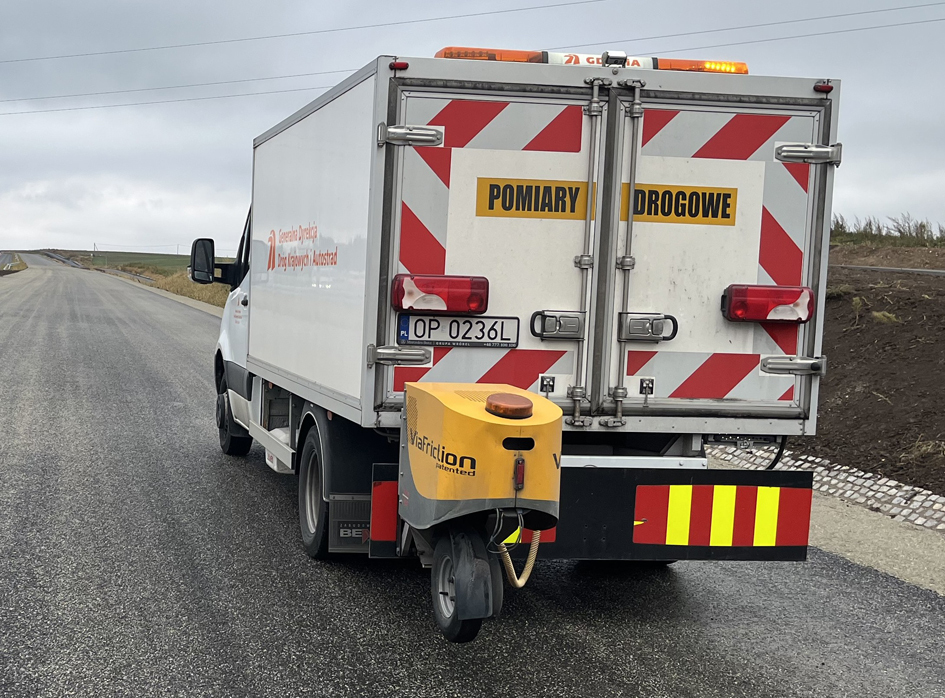
Road surface friction coefficient measured at different slip ratios – comparison of results from the ViaFriction and SRT-3 devices
1
Doctoral School, Opole University of Technology, Poland
2
Faculty of Civil Engineering and Architecture, Department of Building Materials
Engineering, Opole University of Technology, Poland
3
Faculty of Civil Engineering and Architecture, Department of Materials Physics, Opole University of Technology, Poland
4
Faculty of Civil and Environmental Engineering, Department of Civil and Communication Engineering, West Pomeranian University of Technology, Poland
Submission date: 2025-09-03
Acceptance date: 2026-02-19
Publication date: 2026-09-25
Corresponding author
Zbigniew Perkowski
Faculty of Civil Engineering and Architecture, Department of Building Materials Engineering, Opole University of Technology, Katowicka 48, 45-061, Opole, Poland
Faculty of Civil Engineering and Architecture, Department of Building Materials Engineering, Opole University of Technology, Katowicka 48, 45-061, Opole, Poland
Archives of Civil Engineering 2026;72(3):269-283
KEYWORDS
TOPICS
ABSTRACT
The anti-skid properties of road surface play a key role in ensuring the safety of road users. The paper emphasizes the need to use friction coefficient measurement with a variable slip of the test wheel, which allows for more detailed control of the surface technical condition, e.g., using the ViaFriction device. In Poland, the minimum required friction coefficient values have so far been clearly defined only for the SRT-3 device with the locked wheel. This was the motivation for the authors to compare the results of friction coefficient measurements from the SRT-3 and ViaFriction devices. The tests were conducted on selected road sections in the Opole Voivodeship (Poland), considering two road surface technologies: stone mastic asphalt (SMA) and cement concrete. In the case of SMA, the operating time and the temperature surface were also taken into account. As a result, a strongly correlated linear relation between the friction coefficients from the SRT-3 and ViaFriction devices was found for the SMA surface.
Share
RELATED ARTICLE
| eISSN: | 2300-3103 |
| ISSN: | 1230-2945 |

We process personal data collected when visiting the website. The function of obtaining information about users and their behavior is carried out by voluntarily entered information in forms and saving cookies in end devices. Data, including cookies, are used to provide services, improve the user experience and to analyze the traffic in accordance with the Privacy policy. Data are also collected and processed by Google Analytics tool (more).
You can change cookies settings in your browser. Restricted use of cookies in the browser configuration may affect some functionalities of the website.
You can change cookies settings in your browser. Restricted use of cookies in the browser configuration may affect some functionalities of the website.