


Research on the full life cycle safety of levee based on BIM+mechanism algorithm
1
Strategic Research Department, Zhejang Design Instute Of Water Conservancy & Hydro-Electric Power CO. LTD, China
2
Hohai University, China
Submission date: 2024-09-01
Final revision date: 2024-12-17
Acceptance date: 2025-02-11
Publication date: 2026-06-14
Corresponding author
Wei Liu
Strategic Research Department, Zhejang Design Instute Of Water Conservancy & Hydro-Electric Power CO. LTD, HangZhou, China
Strategic Research Department, Zhejang Design Instute Of Water Conservancy & Hydro-Electric Power CO. LTD, HangZhou, China
Archives of Civil Engineering 2026;72(2):247-263
KEYWORDS
TOPICS
ABSTRACT
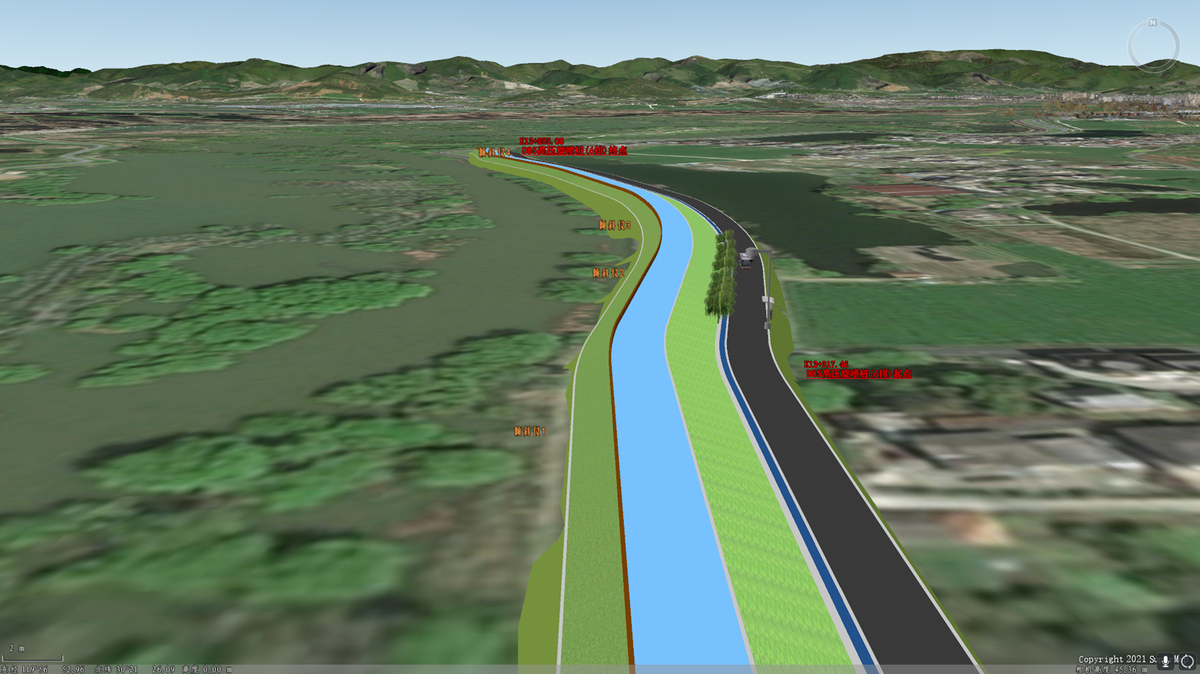
Levee is the oldest and most widely used water conservancy project in human society, and its safety is directly related to the safety of people's lives and property. According to current regulations, calculations about seepage stability and sliding stability are required during the design and operation management of levees,which including section modeling, soil index organization and boundary condition setting. Due to the characteristic of long distance and multiple sections , these calculations are time-consuming, labor-intensive, and prone to manual errors. This article proposes an innovative research method for the full life cycle safety of levees based on BIM+Mechanisma algorithm. Take West danger Levee project for example, firstly study the three-dimensional geological modeling of levees based on databases, providing the physical and mechanical properties data of geological strata for subsequent calculations; then improve the efficiency of structural modeling and modification by BIM parametric design; finally, construct BIM+GIS data base to integrate the structural and geological information. Then, this article develops finite element seepage calculation program and limit equilibrium method calculation program, further more providing data and functional interfaces to support online calling of external programs. The above research is used for levee design, extracting calculation models from design sections and calling calculation modules for batch solving, hereby improving the situation where levee design and calculations are separated from each other and enhancing design optimization efficiency. On the other hand, applied to digital twin, the safety data base and Mechanism Algorithms of levee are used for safety evaluation after construction.
Share
RELATED ARTICLE
| eISSN: | 2300-3103 |
| ISSN: | 1230-2945 |

We process personal data collected when visiting the website. The function of obtaining information about users and their behavior is carried out by voluntarily entered information in forms and saving cookies in end devices. Data, including cookies, are used to provide services, improve the user experience and to analyze the traffic in accordance with the Privacy policy. Data are also collected and processed by Google Analytics tool (more).
You can change cookies settings in your browser. Restricted use of cookies in the browser configuration may affect some functionalities of the website.
You can change cookies settings in your browser. Restricted use of cookies in the browser configuration may affect some functionalities of the website.