


Benefits of building information modelling in mitigating claims and disputes of construction projects in Jordan
1
Civil and Infrastructure Engineering Department,, Al-Zaytoonah University of Jordan, Amman, Jordan, Jordan
2
Faculty of Engineering and Technology, Civil and Infrastructure Engineering Department, Al-Zaytoonah University of Jordan, Amman, Jordan
3
Faculty of Civil Engineering Technology, Faculty of Civil Engineering Technology, Universiti Malaysia Pahang AL-Sultan Abdullah, Persiaran Tun Khalil Yaakob, 26300, Pahang, Gambang, Malaysia, Malaysia
These authors had equal contribution to this work
Submission date: 2024-11-10
Final revision date: 2024-12-29
Acceptance date: 2025-01-21
Publication date: 2026-06-14
Corresponding author
Mohammad I. Al Biajawi
Faculty of Civil Engineering Technology, Faculty of Civil Engineering Technology, Universiti Malaysia Pahang AL-Sultan Abdullah, Persiaran Tun Khalil Yaakob, 26300, Pahang, Gambang, Malaysia, Kuantan, Gambang, Lebuhraya Tun Razak, 26300, Pahang, Malaysia
Faculty of Civil Engineering Technology, Faculty of Civil Engineering Technology, Universiti Malaysia Pahang AL-Sultan Abdullah, Persiaran Tun Khalil Yaakob, 26300, Pahang, Gambang, Malaysia, Kuantan, Gambang, Lebuhraya Tun Razak, 26300, Pahang, Malaysia
Archives of Civil Engineering 2026;72(2):433-454
KEYWORDS
TOPICS
ABSTRACT
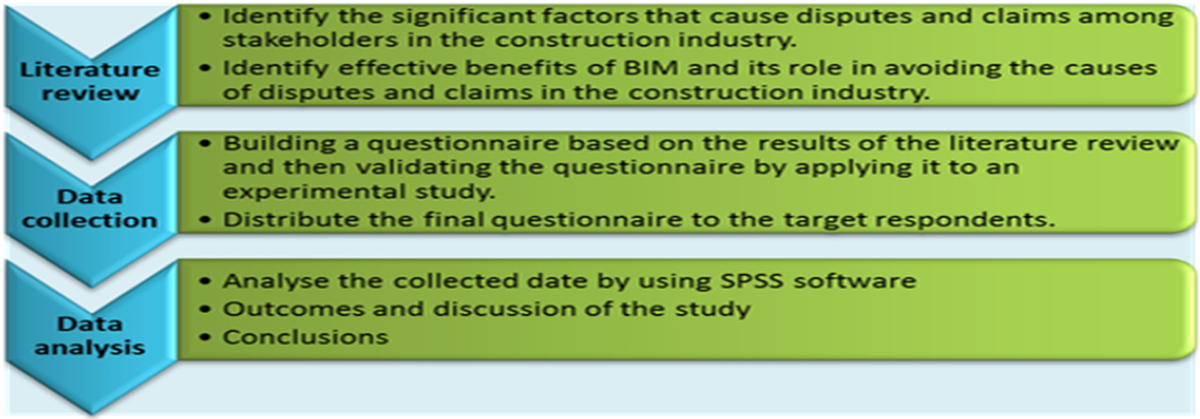
Claims play an important role in construction projects as they can have a significant financial impact that can affect the overall cost and schedule of the project. The introduction of Building Information Modeling (BIM) is changing the traditional methods of the construction industry and has strengthened the influence of the planning process on the entire life cycle of a construction project. Therefore, this research attempts to identify the function of Building Information Modeling (BIM) in mitigating such claims and disputes. To achieve the aim of this research, 380 assessments done by industry specialists were examined using the mean ranking method, the normalization process, the RII and factor analysis. The results of this study quantify the main causes of claims and disputes associated with the contractor and owner, such as financial problems of the contractor (RII 0.792), delays caused by the contractor (RII 0.784), delays in payment of completed work to the contractor (RII 0.794), oral change orders from the owner (RII 0.790). In addition, the results revealed several potential benefits of BIM that include efficient communications between stakeholders (RII 0.852), better visualization (RII 0.846), 3D-Coordination and clash detection (RII 0.830). This survey contributes to the current form of information by identifying the main sources of disputes and claims in projects. In addition to revealing the benefits of BIM that industry experts can use to improve project performance.
Share
RELATED ARTICLE
| eISSN: | 2300-3103 |
| ISSN: | 1230-2945 |

We process personal data collected when visiting the website. The function of obtaining information about users and their behavior is carried out by voluntarily entered information in forms and saving cookies in end devices. Data, including cookies, are used to provide services, improve the user experience and to analyze the traffic in accordance with the Privacy policy. Data are also collected and processed by Google Analytics tool (more).
You can change cookies settings in your browser. Restricted use of cookies in the browser configuration may affect some functionalities of the website.
You can change cookies settings in your browser. Restricted use of cookies in the browser configuration may affect some functionalities of the website.