


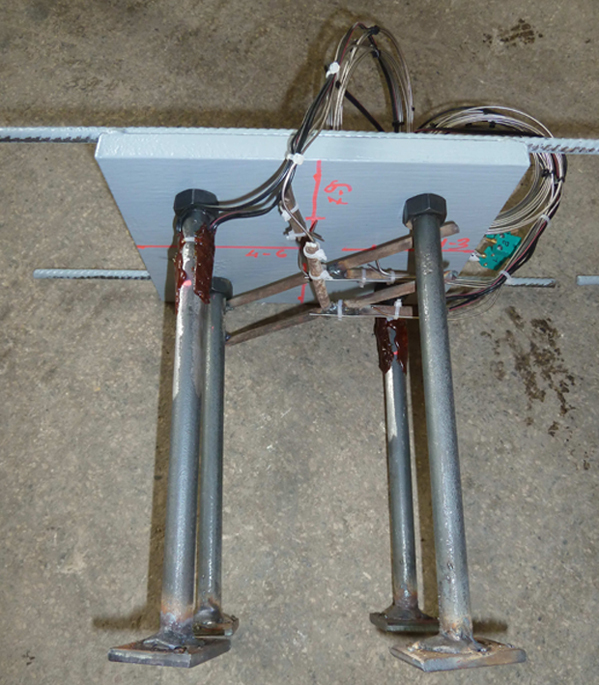
Experimental tests and FEM modelling of thermal effects of the welding process on steel anchor plates embedded in concrete

1
Wydział Inżynierii Lądowej, Politechnika Warszawska, Poland
2
Warsaw University of Technology, Faculty of Civil Engineering
Submission date: 2025-04-03
Final revision date: 2025-06-20
Acceptance date: 2025-07-01
Publication date: 2026-09-25
Corresponding author
Stanisław Wierzbicki
Wydział Inżynierii Lądowej, Politechnika Warszawska, Al. Armii Ludowej 16, 00-637, Warszawa, Poland
Wydział Inżynierii Lądowej, Politechnika Warszawska, Al. Armii Ludowej 16, 00-637, Warszawa, Poland
Archives of Civil Engineering 2026;72(3):151-167
KEYWORDS
TOPICS
ABSTRACT
The paper discusses experimental tests and numerical analyses of welded steel anchor plates embedded in concrete. The purpose of the research was to assess thermal effects of the welding process on the plates and the concrete in which they were embedded. This assessment concerned both the effect of temperature on the material and the effects caused by the phenomenon of thermal expansion of steel. Parameters of the tested elements were selected so that they would reflect typical solutions applied in practice. The basic research consisted in welding gusset plates to anchor plates embedded in concrete and measuring temperatures at characteristic points of the tested elements. The FEM analysis model was built in a way ensuring that it would reflect the thermal effects accompanying the welding processes and the changing material parameters of the tested elements, i.e. steel and concrete, as well as various contact phenomena occurring between these materials. The need to take all these aspects into account considerably reduced the number of available numerical tools, limiting them to universal FEM programs, such as Abaqus and Ansys, where in the end Ansys was used in the analyses. The paper describes the testing procedures, FEM modelling, and presents the results of the research and analyses in question. The conducted research has shown that although the thermal effects of the welding process on the parameters of concrete are not significant, the thermal expansion of steel results in deformations of the plate sufficient to lead to damage to concrete layers surrounding the plate.
Share
RELATED ARTICLE
| eISSN: | 2300-3103 |
| ISSN: | 1230-2945 |

We process personal data collected when visiting the website. The function of obtaining information about users and their behavior is carried out by voluntarily entered information in forms and saving cookies in end devices. Data, including cookies, are used to provide services, improve the user experience and to analyze the traffic in accordance with the Privacy policy. Data are also collected and processed by Google Analytics tool (more).
You can change cookies settings in your browser. Restricted use of cookies in the browser configuration may affect some functionalities of the website.
You can change cookies settings in your browser. Restricted use of cookies in the browser configuration may affect some functionalities of the website.