


Comprehensive analysis of the temperature stress of the ice sheet in a prefabricated curling ice rink
1
School of Civil Engineering and Architecture, Nanyang Normal University, China
2
School of Civil Engineering, Harbin Institute of Technology, China
Submission date: 2025-01-16
Final revision date: 2025-04-21
Acceptance date: 2025-04-29
Publication date: 2026-09-25
Corresponding author
Archives of Civil Engineering 2026;72(3):35-50
KEYWORDS
prefabricated ice rinkice sheettemperature fieldtemperature stressfinite elementmodellingdistribution characteristic
TOPICS
ABSTRACT
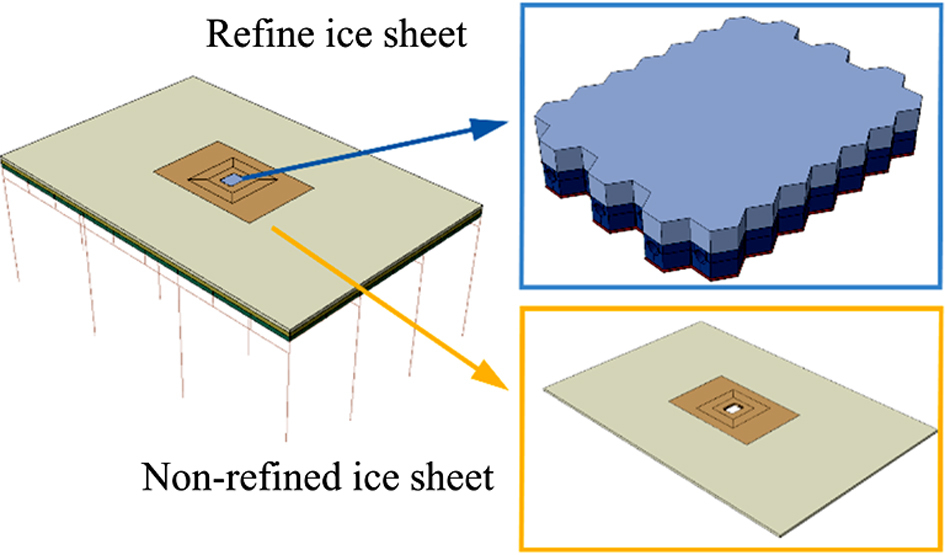
Prefabricated ice rinks represent a novel category of artificial ice rinks that exhibit significant potential due to low refrigeration energy consumption, multifunctional capabilities, and ease of assembly. Given the ice’s considerable thickness and significant temperature gradient, it is imperative to investigate the temperature-induced stresses. Three temperature models of the prefabricated rink, considering the actual thermal environment, were established based on the theory of heat transfer. Employing the sequential coupled analysis method, a refined model for analyzing temperature stress within the ice was established. A method for applying temperature to un-refined ice sheet was proposed, utilizing the mathematical functions derived from temperature distribution results. The distribution characteristics of temperature stress fields and the influence of various heat exchange processes were examined. Additionally, the effects of different thermal environment factors on temperature stress were analyzed, and parameters sensitivities were determined. The results show that honeycomb supports are not suitable for embedding constraints analogous to reinforced concrete. The critical temperature-induced tensile stress occurs beneath cooling tubes interfacing with ice, with its magnitude showing positive correlation with refrigerant-driven ice temperature reduction. In contrast, reducing ice temperature through thermal convection and radiation results in a decrease in tensile stress. Parameter analysis reveals that refrigerant constitutes the principal governing factor for temperature stress development. This study would contribute to the performance analysis of ice rinks under thermal-mechanical coupling effects.
Share
RELATED ARTICLE
| eISSN: | 2300-3103 |
| ISSN: | 1230-2945 |

We process personal data collected when visiting the website. The function of obtaining information about users and their behavior is carried out by voluntarily entered information in forms and saving cookies in end devices. Data, including cookies, are used to provide services, improve the user experience and to analyze the traffic in accordance with the Privacy policy. Data are also collected and processed by Google Analytics tool (more).
You can change cookies settings in your browser. Restricted use of cookies in the browser configuration may affect some functionalities of the website.
You can change cookies settings in your browser. Restricted use of cookies in the browser configuration may affect some functionalities of the website.