


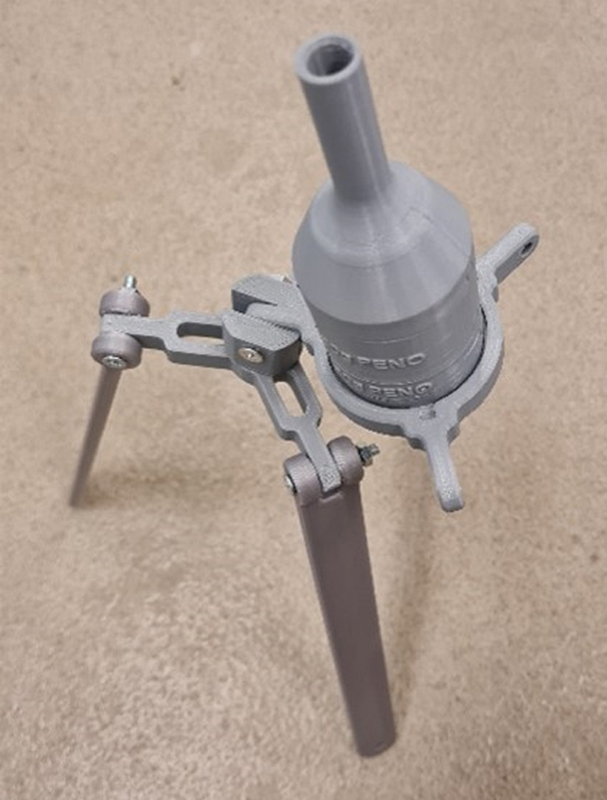
Study on the close distance perforation capabilities of explosively formed penetrators
1
Faculty of Mechanical Engineering, WOJSKOWA AKADEMIA TECHNICZNA im. Jarosława Dąbrowskiego, Poland
Submission date: 2025-02-25
Acceptance date: 2025-05-06
Publication date: 2026-06-14
Corresponding author
Sebastian Stanislawek
Faculty of Mechanical Engineering, WOJSKOWA AKADEMIA TECHNICZNA im. Jarosława Dąbrowskiego, ul. Gen. Witolda Urbanowicza 2, 00-908 Warszawa 46, Warsaw, Poland
Faculty of Mechanical Engineering, WOJSKOWA AKADEMIA TECHNICZNA im. Jarosława Dąbrowskiego, ul. Gen. Witolda Urbanowicza 2, 00-908 Warszawa 46, Warsaw, Poland
Archives of Civil Engineering 2026;72(2):155-168
KEYWORDS
explosively formed penetratorEFPperforationcomputational mechanicsfinite elementmethodarbitrary Lagrangian–Eulerian
TOPICS
ABSTRACT
The paper presents a study of the perforation capabilities of Explosively Formed Penetrators (EFP) at small distances between the charge placement and a target for the selected charge configurations. The specific design of the warhead is considered, where the casing is made of light, low-strength material and the warhead may be installed directly on the obstacle, which makes it valuable for special applications. The problem was solved using modelling and simulation methods, in particular, CFD-FEM implemented in the Ls-Dyna code. It was assumed as an axisymmetric issue in computational fluid dynamics, where space discretization for each option was built with two-dimensional elements, which ensured efficient calculations. The core numerical model was successfully validated based on the available data in quantitative terms. Analyses showed that at close ranges, under two diameters of the liner, the projectile fails to reach its optimal parameters, impacting the target with relatively low velocity. This effectiveness is also deteriorated by the projectile's geometry, which at this moment is still not final. Studies on the projectile's post perforation energy revealed a dependency on the EFP's distance from the target, with the most significant effects observed within a range of one liner diameter. Beyond the distance of two diameters, further changes in effectiveness are minimal, with slight variations attributed to computational method inaccuracies.
Share
RELATED ARTICLE
| eISSN: | 2300-3103 |
| ISSN: | 1230-2945 |

We process personal data collected when visiting the website. The function of obtaining information about users and their behavior is carried out by voluntarily entered information in forms and saving cookies in end devices. Data, including cookies, are used to provide services, improve the user experience and to analyze the traffic in accordance with the Privacy policy. Data are also collected and processed by Google Analytics tool (more).
You can change cookies settings in your browser. Restricted use of cookies in the browser configuration may affect some functionalities of the website.
You can change cookies settings in your browser. Restricted use of cookies in the browser configuration may affect some functionalities of the website.