


Bottom-up casting of self-compacting concrete as a factor improving steel-concrete bond strength

1
Faculty of Civil Engineering and Resource Management, AGH University of Krakow, Poland
These authors had equal contribution to this work
Submission date: 2025-09-02
Acceptance date: 2025-09-16
Publication date: 2026-09-25
Corresponding author
Milena Kucharska
Faculty of Civil Engineering and Resource Management, AGH University of Krakow, Aleja Mickiewicza 30, 30-059, Krakow, Poland
Faculty of Civil Engineering and Resource Management, AGH University of Krakow, Aleja Mickiewicza 30, 30-059, Krakow, Poland
Archives of Civil Engineering 2026;72(3):241-255
KEYWORDS
bondbottom-up castingnew generation concretesself-compacting concretetechnological factorstop-bar effect
TOPICS
ABSTRACT
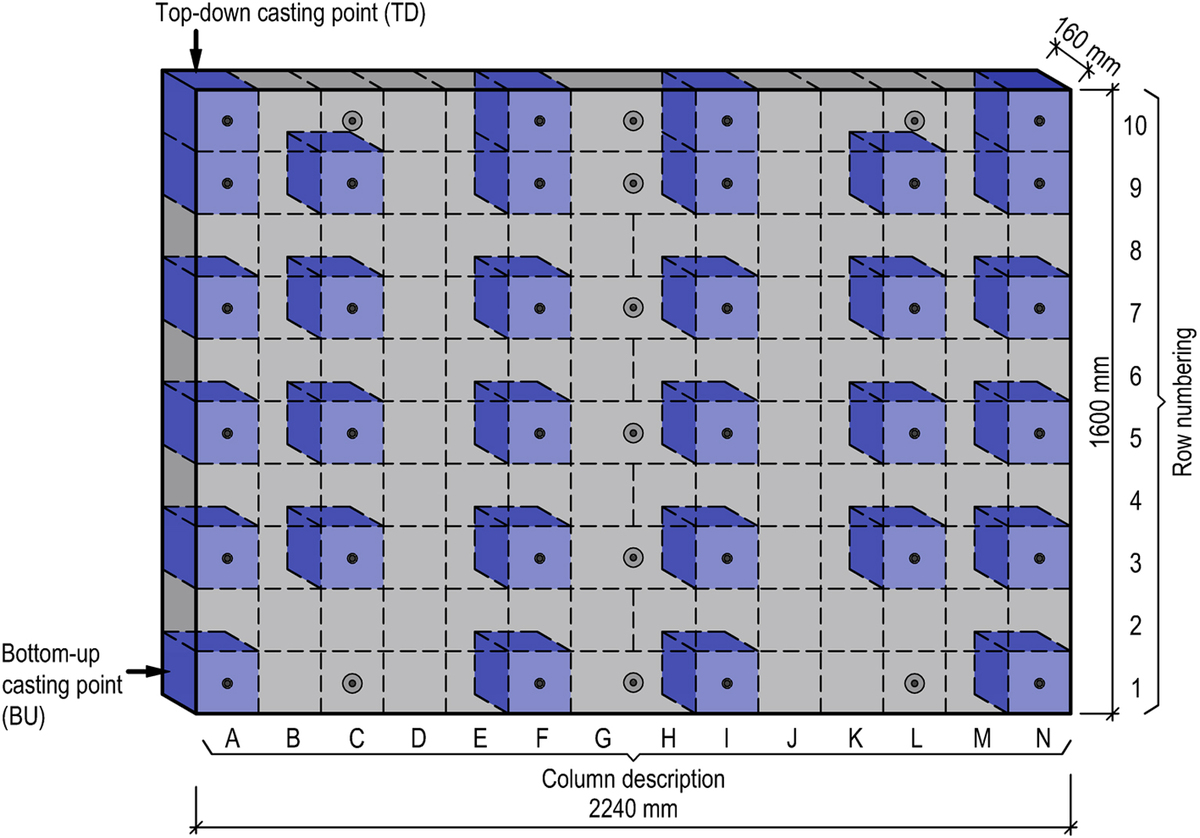
This study investigates the impact of bottom-up casting on the bond behaviour between reinforcing steel and self-compacting concrete in full-scale structural wall elements. Through experimental pull-out tests and X-ray computed tomography, a comparison is made between bottom-up casting and the conventional top-down method. A wall-type test element measuring 2240×1600×160 mm was designed for the study. The results obtained from this study demonstrate that bottom-up casting technology significantly enhances bond strength, showing a 10% increase in normalised bond strength. This improvement in bond strength is attributed to enhanced consolidation and deaeration of the mix during the casting process, which serves to minimise defects such as air voids. Additionally, the bottom-up method leads to more uniform bond distribution along the height of the wall, thereby reducing the top-bar effect commonly seen in top-down casting. Tomographic scans revealed a reduced presence of air voids in the cover zone of bottom-up cast elements, providing further evidence of superior material compaction. The study concludes that bottom-up casting holds promise for improving SCC element performance, especially in applications where bond quality and uniformity are critical.
Share
RELATED ARTICLE
| eISSN: | 2300-3103 |
| ISSN: | 1230-2945 |

We process personal data collected when visiting the website. The function of obtaining information about users and their behavior is carried out by voluntarily entered information in forms and saving cookies in end devices. Data, including cookies, are used to provide services, improve the user experience and to analyze the traffic in accordance with the Privacy policy. Data are also collected and processed by Google Analytics tool (more).
You can change cookies settings in your browser. Restricted use of cookies in the browser configuration may affect some functionalities of the website.
You can change cookies settings in your browser. Restricted use of cookies in the browser configuration may affect some functionalities of the website.