


Reactive scheduling of repetitive construction projects by allocating additional resources
1
Faculty of Civil Engineering and Architecture, Lublin University of Technology, Poland
2
Faculty of Civil Engineering, Warsaw University of Technology, Poland
3
Department of Civil Engineering, Bulent Ecevit University, Turkey
These authors had equal contribution to this work
Submission date: 2024-10-23
Acceptance date: 2024-11-05
Publication date: 2025-12-01
Corresponding author
Piotr Jaśkowski
Faculty of Civil Engineering and Architecture, Lublin University of Technology, Nadbystrzycka 38d, 20-618, Lublin, Poland
Faculty of Civil Engineering and Architecture, Lublin University of Technology, Nadbystrzycka 38d, 20-618, Lublin, Poland
Archives of Civil Engineering 2025;71(4):559-572
KEYWORDS
construction project schedulingreactive schedulingresources allocationmathematical modellinglinear programming
TOPICS
ABSTRACT
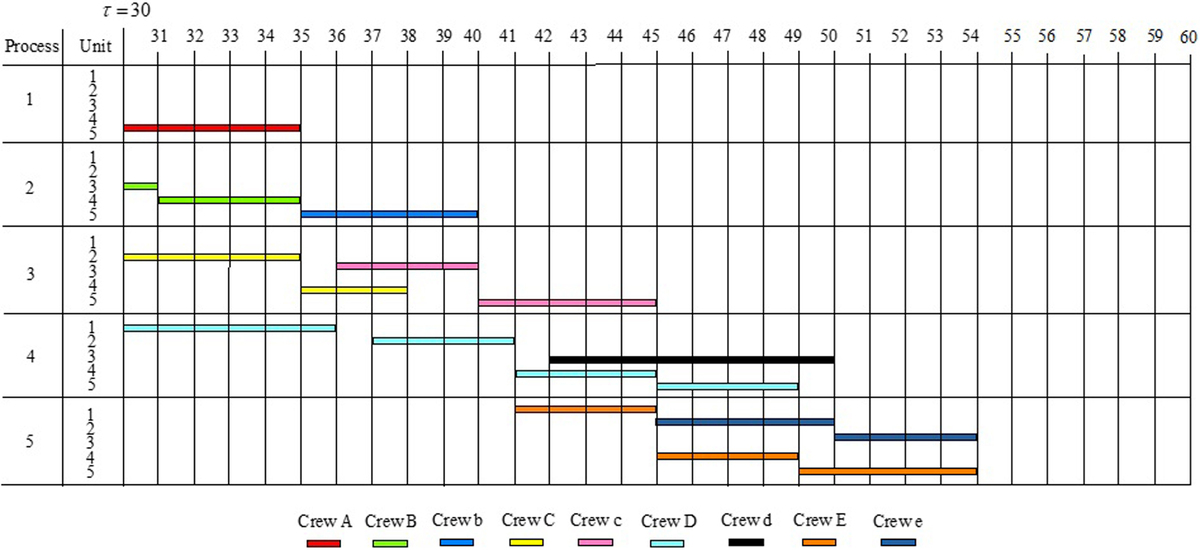
Repetitive construction projects involve the sequential execution of the same type of construction process at different locations (units). Work crews responsible for a particular type of process complete their work in one unit and then move on to the next. In practice, it is not possible to divide the built facility into identical units. In such a case, reducing the execution time of the project leads to interruptions in the workflow of the crews. Better results can be achieved by changing the order in which the units are processed by the crews. The use of the flow-shop system, well known in production scheduling, makes it possible to reduce the execution time of this type of projects, but makes the schedules vulnerable to random disturbances: the resulting delays can propagate throughout the schedule and generate idle time for crews completing their processes on time. Therefore, rescheduling may become inevitable to meet the deadlines. This paper presents a linear programming mathematical model for reactive scheduling that takes into account the possibility of allocating additional crews and allows for the possibility of changing the sequence of units. It makes it possible to meet the target date for completion of the project and to reduce the downtime of the working crews. The proposed approach to respond to schedule disruptions is illustrated by an example. Potential tools for solving the model were also pointed out, which can form the basis for creating a decision support system in the execution phase of repetitive projects.
Share
RELATED ARTICLE
| eISSN: | 2300-3103 |
| ISSN: | 1230-2945 |

We process personal data collected when visiting the website. The function of obtaining information about users and their behavior is carried out by voluntarily entered information in forms and saving cookies in end devices. Data, including cookies, are used to provide services, improve the user experience and to analyze the traffic in accordance with the Privacy policy. Data are also collected and processed by Google Analytics tool (more).
You can change cookies settings in your browser. Restricted use of cookies in the browser configuration may affect some functionalities of the website.
You can change cookies settings in your browser. Restricted use of cookies in the browser configuration may affect some functionalities of the website.