


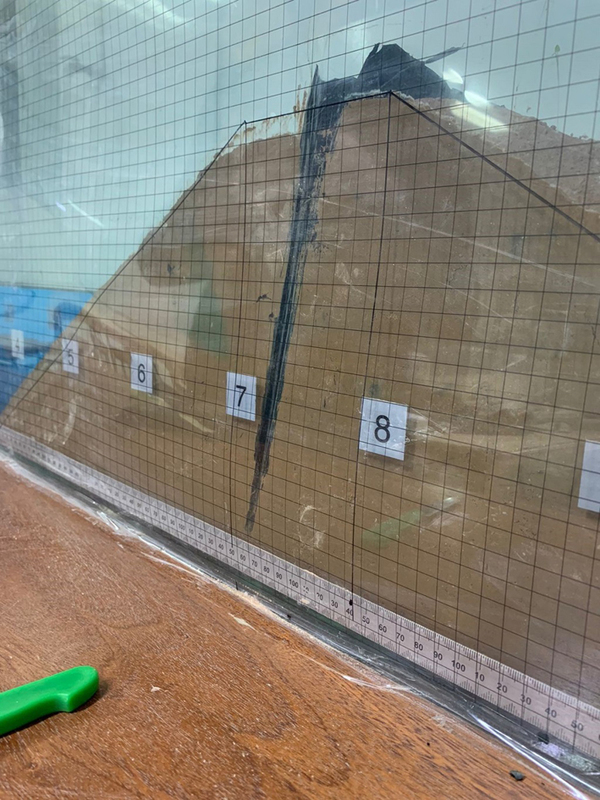
Experimental work: the effect of using agricultural pond insulators in the core of earthen dams on water flow and dissolved solids content
1
civil Engineering, alzaytoonah university of jordan, Jordan
2
civil engineering, the university of jordan, Jordan
3
civil engineeering, jordan, Jordan
Submission date: 2024-09-19
Final revision date: 2024-11-02
Acceptance date: 2024-12-10
Publication date: 2025-12-01
Corresponding author
Anwar Tarawneh
civil Engineering, alzaytoonah university of jordan, Amman /ali airport, 11733, Amman, Jordan
civil Engineering, alzaytoonah university of jordan, Amman /ali airport, 11733, Amman, Jordan
Archives of Civil Engineering 2025;71(4):543-557
KEYWORDS
TOPICS
ABSTRACT
Gypsies soils are frequently found in semiarid and arid environments where rainfall does not sufficiently let the gypsum to leach from the soil cover. The efficiency of dams that impound water is reduced by a number of factors, including the breakdown of gypsum salts that lead to caverns, an increase in soil material permeability, an increase in flow rate caused by expanding fissures, and an excessive settlement rate. This work aims to understand the behavior of earth dams containing gypsum salts in their structure and the effect of isolation on their permeability and the amount of salts in the water flowing from them. To determine the amount of seepage through the dam body and the location of the phreatic line, a model was developed using actual samples from one of the backfill dams. Then, in addition to gypsum salts, we constructed an additional model for the same samples. We identified the phreatic line's position, velocity, change in flow and total dissolved solid. Then, using Geo Studio software, we simulated the two models. The results showed that the flow increased with the addition of gypsum salts and the formation of the phreatic line began after a period of time estimated at 16 hours in the first model and appeared in the second model after 12 hours, which is the sample containing gypsum salts. However, the insulator prevented leakage through the dam body by 89% in the third model.
| eISSN: | 2300-3103 |
| ISSN: | 1230-2945 |

We process personal data collected when visiting the website. The function of obtaining information about users and their behavior is carried out by voluntarily entered information in forms and saving cookies in end devices. Data, including cookies, are used to provide services, improve the user experience and to analyze the traffic in accordance with the Privacy policy. Data are also collected and processed by Google Analytics tool (more).
You can change cookies settings in your browser. Restricted use of cookies in the browser configuration may affect some functionalities of the website.
You can change cookies settings in your browser. Restricted use of cookies in the browser configuration may affect some functionalities of the website.