


Optimizing of concreting method in mass concrete structure using numerical analysis (roller compacted concrete gravity dam)
1
Department of Civil and Enviromental Engineering, Gadjah Mada University, Indonesia
Submission date: 2024-11-29
Final revision date: 2025-01-21
Acceptance date: 2025-02-11
Publication date: 2026-06-14
Corresponding author
Bambang Supriyadi
Department of Civil and Enviromental Engineering, Gadjah Mada University, Indonesia
Department of Civil and Enviromental Engineering, Gadjah Mada University, Indonesia
Archives of Civil Engineering 2026;72(2):529-544
KEYWORDS
TOPICS
ABSTRACT
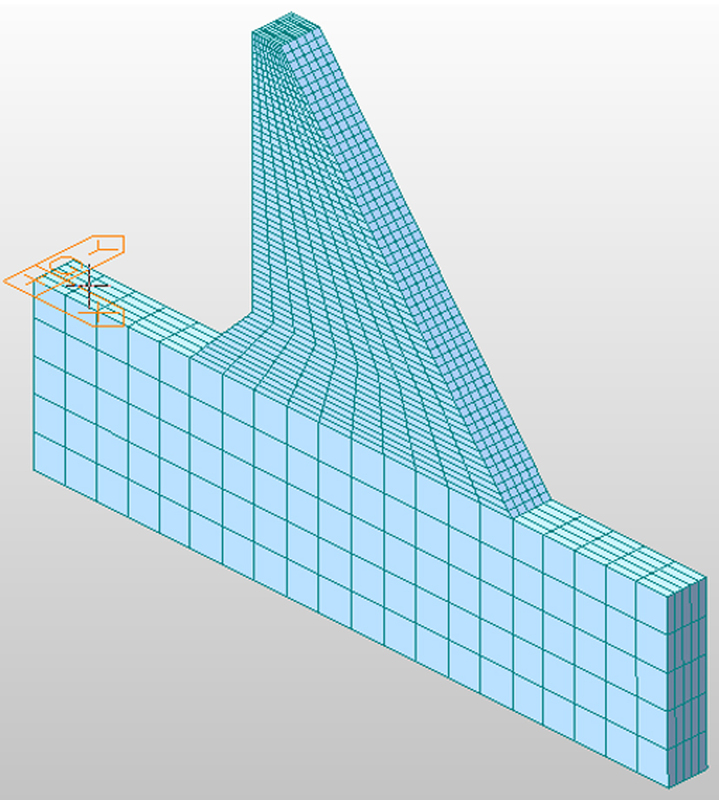
In mass concrete structures, the increase in temperature due to hydration heat must be carefully studied to minimize the risk of thermal cracking. Gravity dams, a type of mass concrete structure, rely on their own weight to resist the pressure of water. An important innovation in civil construction is Roller-Compacted Concrete (RCC), a form of concrete compacted using a roller compactor. In this study, 3D numerical simulations were conducted using Midas Civil software to analyze the development of hydration temperature within the RCC Tannur Gravity Dam structure in Jordan. The 3D geometric modeling was limited to the cross-section (middle section) of a 15-meter-wide monolithic dam block, assuming symmetry on both sides of the section. Adiabatic boundary conditions were applied to the model to prevent heat loss from the cement hydration reaction. A construction stage analysis was conducted to determine the temperature evolution during each stage of concrete placement. Several simulation scenarios were analyzed, varying the layer thickness (3 m and 4 m), the concreting sequence, and the initial placement temperature of the RCC (20°C, 25°C, 30, and 35°C). Concreting Scheme 2 not only lowers the maximum hydration heat temperature and the associated thermal stress but also speeds up the construction of a dam block by increasing the RCC layer thickness. The results of the numerical modeling demonstrated that controlling the heat of hydration in mass concrete structures can be effectively achieved by optimizing construction methods and parameters.
Share
RELATED ARTICLE
| eISSN: | 2300-3103 |
| ISSN: | 1230-2945 |

We process personal data collected when visiting the website. The function of obtaining information about users and their behavior is carried out by voluntarily entered information in forms and saving cookies in end devices. Data, including cookies, are used to provide services, improve the user experience and to analyze the traffic in accordance with the Privacy policy. Data are also collected and processed by Google Analytics tool (more).
You can change cookies settings in your browser. Restricted use of cookies in the browser configuration may affect some functionalities of the website.
You can change cookies settings in your browser. Restricted use of cookies in the browser configuration may affect some functionalities of the website.