


Inelastic column buckling mechanism
1
Faculty of Automotive and Construction Machinery Engineering, Warsaw University of Technology, Poland
Submission date: 2024-05-06
Final revision date: 2024-07-11
Acceptance date: 2024-09-03
Publication date: 2025-12-01
Corresponding author
Mirosław Zbigniew Szymański
Faculty of Automotive and Construction Machinery Engineering, Warsaw University of Technology, Ludwika Narbutta, 02-524, Warsaw, Poland
Faculty of Automotive and Construction Machinery Engineering, Warsaw University of Technology, Ludwika Narbutta, 02-524, Warsaw, Poland
Archives of Civil Engineering 2025;71(4):169-184
KEYWORDS
buckling mechanismHuber-Mises-Henckyinelastic column theoryinternal stabilitymaterial effort hypothesis
TOPICS
ABSTRACT
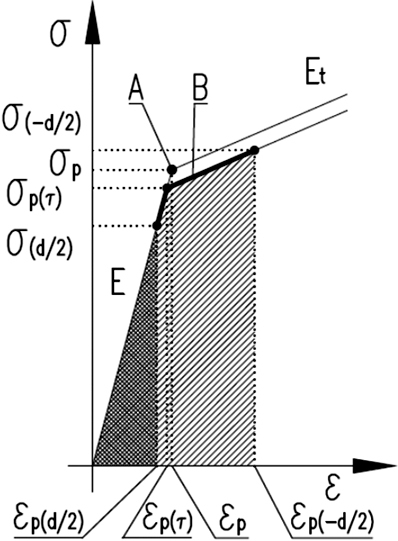
This paper presents attempt to explain the phenomenon of the stability loss of prismatic columns, made of metal, loaded beyond the yield limit. The explanation is presented on the base of Euler’s theory, tangent modulus theory, reduced modulus theory, Shanley’s column paradox and inelastic column theory. Explanation refers to results of experiments performed by many scientists, including F. R. Shanley, and related to Huber-Mises-Hencky (HMH) hypothesis of material effort. The use of HMH material effort hypothesis to analyse buckling column within inelastic range enables to explain the mechanism of buckling (including strain development) observed by F. R. Shanley and points out that the column paradox does not exist. The change of the uniform state of strain and stress to the non-uniform state which does not lead to loss of total stability by column is referred to as the loss of internal stability. The concept is presented on the base of idealised stress-strain diagram (bilinear elasto-plastic model).
| eISSN: | 2300-3103 |
| ISSN: | 1230-2945 |

We process personal data collected when visiting the website. The function of obtaining information about users and their behavior is carried out by voluntarily entered information in forms and saving cookies in end devices. Data, including cookies, are used to provide services, improve the user experience and to analyze the traffic in accordance with the Privacy policy. Data are also collected and processed by Google Analytics tool (more).
You can change cookies settings in your browser. Restricted use of cookies in the browser configuration may affect some functionalities of the website.
You can change cookies settings in your browser. Restricted use of cookies in the browser configuration may affect some functionalities of the website.