


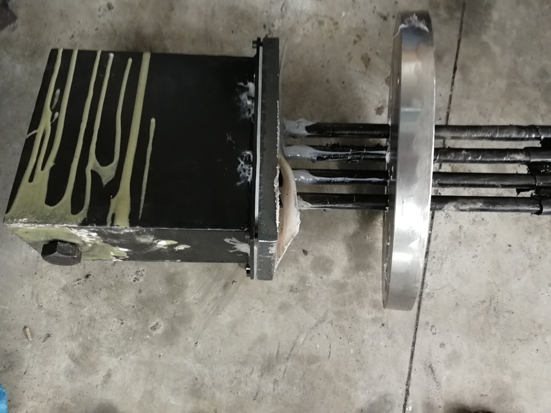
A flat type anchorage system for short tendons with low prestress wedge draw-in loss
1
School of Civil Engineering, Beijing Jiaotong University, China
2
Managers, LiuZhou Qiaosha Technology Development Co.,Ltd, China
3
Road business department, China Railway Design Corporation, China
Submission date: 2024-11-16
Final revision date: 2025-03-21
Acceptance date: 2025-04-23
Publication date: 2026-09-25
Archives of Civil Engineering 2026;72(3):493-508
KEYWORDS
TOPICS
ABSTRACT
Currently, there are drawbacks to the prestressing anchorage products used in prestressed concrete bridges, including significant anchorage draw-in during tensioning, inconveniences during construction, anchorage failure during usage, and operation subject to human interference. In order to overcome these unfavorable factors, a flat low draw-in anchorage system was developed through scheme design, selection, finite element analysis and trial production test. By adjusting the jacking force, this method uses a wedge-shaped structure in the shape of a jacking pad to guarantee that the draw-in value is within 1 mm. Slow bevelled contact, which has high self-locking properties and improves the contact surface while lowering compressive stress, is used between the pad plate and the flat low draw-in anchorage plate at a small angle of rise. Through the structural form of jacking the mat plate, jacking it into place at one time, and quantitatively controlling the value of jacking force, the system achieves standardized construction and reduces errors in human operation. The wedge anchorage system performs exceptionally well in terms of safety under simulated operating conditions, according to finite element analysis. After the fatigue test verification study, there was no fatigue damage to the anchorage parts, and the prestressed tendons were not broken. In the meantime, the sealing test revealed that there was no breakage of the anchorage's components, and that there were no leaks or water stains inside the tendons or the anchoring itself. This system offers a solid assurance against girder deflection, web cracking in pre-stressed concrete bridges, and other ailments.
Share
RELATED ARTICLE
| eISSN: | 2300-3103 |
| ISSN: | 1230-2945 |

We process personal data collected when visiting the website. The function of obtaining information about users and their behavior is carried out by voluntarily entered information in forms and saving cookies in end devices. Data, including cookies, are used to provide services, improve the user experience and to analyze the traffic in accordance with the Privacy policy. Data are also collected and processed by Google Analytics tool (more).
You can change cookies settings in your browser. Restricted use of cookies in the browser configuration may affect some functionalities of the website.
You can change cookies settings in your browser. Restricted use of cookies in the browser configuration may affect some functionalities of the website.