


Finite element analysis of steel-concrete composite beams with web openings
1
Department of Structural Engineering, Silesian University of Technology, Poland
2
Consultant Engineer, červenka consulting s.r.o, Czech Republic
3
Concrete Structures and Bridges, Slovak Technical University, Slovak Republic
Submission date: 2026-02-19
Acceptance date: 2026-04-07
Publication date: 2026-09-25
Corresponding author
Bilal Ahmed
Department of Structural Engineering, Silesian University of Technology, Akademicka 2A, 44-100, Gliwice, Poland
Department of Structural Engineering, Silesian University of Technology, Akademicka 2A, 44-100, Gliwice, Poland
Archives of Civil Engineering 2026;72(3):109-122
KEYWORDS
TOPICS
ABSTRACT
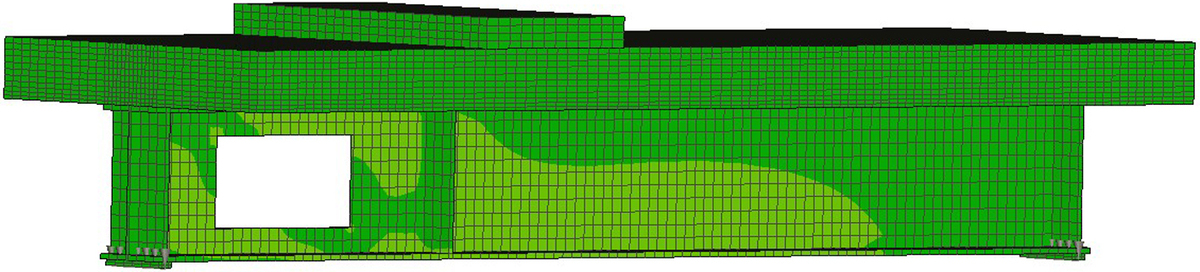
This study investigates the finite element analysis of steel–concrete composite beams with web openings using ATENA Science. Ten beams were modeled and analyzed, with nine containing web openings and one serving as a reference beam without openings. All specimens were fully shear-connected via shear studs. The main parameters studied include concrete flange thickness, reinforcement ratio, and opening height and length. Results indicate that web openings significantly reduce both load-bearing capacity and ultimate stiffness. The concrete slab above the opening carries most of the shear force across the section, contributing considerably to the section's shear capacity. Increasing the concrete flange thickness enhances load-bearing ability, while a higher reinforcement ratio improves deformation capacity. Wider openings substantially increase slip at the interface above the holes, and increasing the height of the openings results in greater shear load transfer to the concrete flange. It was observed that the CB4 concrete slabs carried between 60% and 69% of the total shear force; CB8 resisted about 60%, while CB10 showed a 54% increase in bearing capacity.
Share
RELATED ARTICLE
| eISSN: | 2300-3103 |
| ISSN: | 1230-2945 |

We process personal data collected when visiting the website. The function of obtaining information about users and their behavior is carried out by voluntarily entered information in forms and saving cookies in end devices. Data, including cookies, are used to provide services, improve the user experience and to analyze the traffic in accordance with the Privacy policy. Data are also collected and processed by Google Analytics tool (more).
You can change cookies settings in your browser. Restricted use of cookies in the browser configuration may affect some functionalities of the website.
You can change cookies settings in your browser. Restricted use of cookies in the browser configuration may affect some functionalities of the website.