


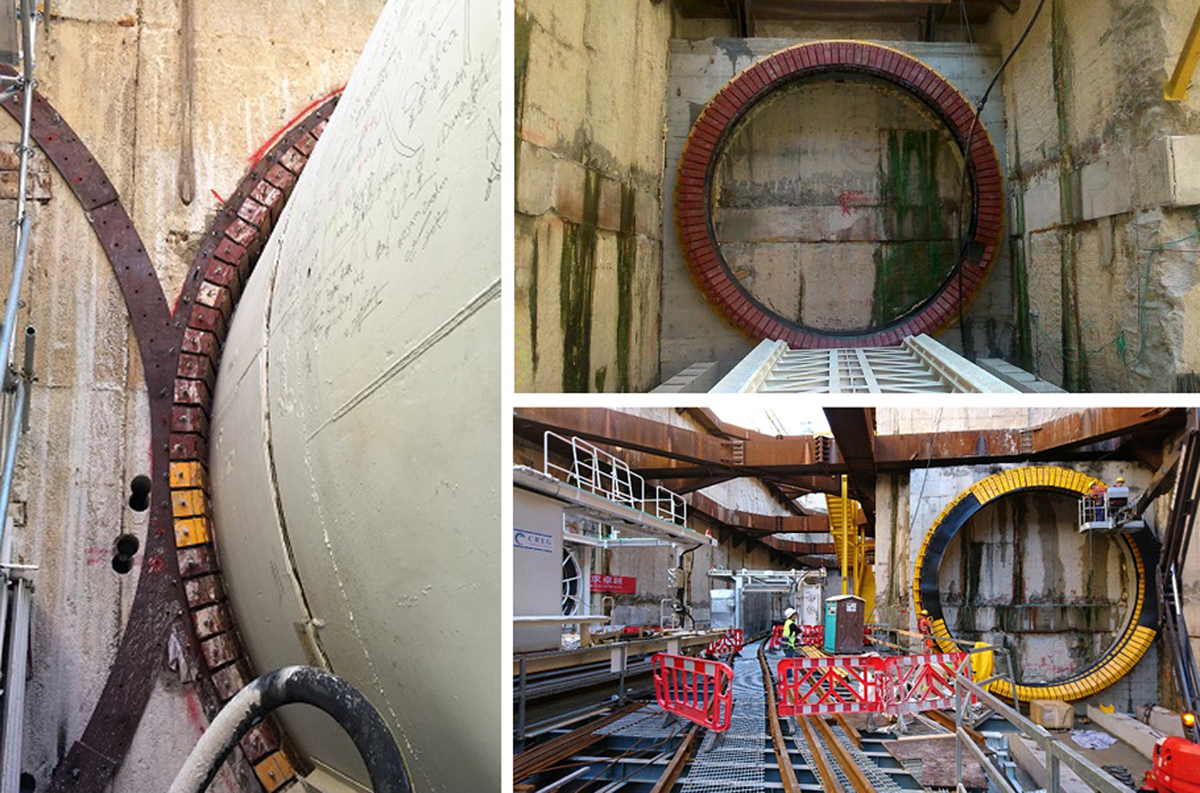
Common engineering methods and control of TBM break-in and break-out operations
1
Faculty of Civil Engineering, Warsaw University of Technology, Poland
Submission date: 2026-03-23
Final revision date: 2026-06-21
Acceptance date: 2026-06-25
Publication date: 2026-09-25
Corresponding author
Emilia Roguska
Faculty of Civil Engineering, Warsaw University of Technology, Al. Armii Ludowej, 00-637, Warsaw, Poland
Faculty of Civil Engineering, Warsaw University of Technology, Al. Armii Ludowej, 00-637, Warsaw, Poland
Archives of Civil Engineering 2026;72(3):603-616
KEYWORDS
TOPICS
ABSTRACT
Break-in and break-out operations represent critical construction phases in shield tunnelling, particularly in water-bearing and heterogeneous ground conditions. During these transitions, temporary modifications in confinement and hydraulic boundary conditions disturb the equilibrium between face support pressure and in-situ stresses, increasing the risk of ground instability and groundwater inflow. The paper discusses the mechanical behavior of the ground during TBM breakthrough through diaphragm walls and station boxes, with emphasis on operational pressure control, annular gap sealing and monitoring requirements. Selected engineering solutions applied to mitigate breakthrough risks are presented, including sealing rings, cement concrete blocks and ground improvement techniques. Their structural configuration, operational role and limitations are analyzed in relation to groundwater pressure and soil permeability. Practical implementation is illustrated through case studies from metro projects, including the FGC Terrassa extension and Sofia Metro Line 3, where combined mechanical and geotechnical measures were adopted to ensure safe TBM transition under low cover and high groundwater conditions. The presented examples confirm that successful breakthrough operations require integrated design combining structural solutions, ground treatment and strict operational control. Break-in and break-out should therefore be treated as governing design stages in tunnel portal engineering rather than routine construction steps.
Share
RELATED ARTICLE
| eISSN: | 2300-3103 |
| ISSN: | 1230-2945 |

We process personal data collected when visiting the website. The function of obtaining information about users and their behavior is carried out by voluntarily entered information in forms and saving cookies in end devices. Data, including cookies, are used to provide services, improve the user experience and to analyze the traffic in accordance with the Privacy policy. Data are also collected and processed by Google Analytics tool (more).
You can change cookies settings in your browser. Restricted use of cookies in the browser configuration may affect some functionalities of the website.
You can change cookies settings in your browser. Restricted use of cookies in the browser configuration may affect some functionalities of the website.