


Uniaxial compression experiments and numerical simulations of artificial rock samples with regular dentate discontinuity
1
School of Civil Engineering and Architecture, East China JiaoTong University, China
2
China Construction Eighth Engineering Division.Corp.Ltd Southwest Branch., China
3
Faculty of Geosciences and Environmental Engineering, Southwest Jiaotong University, China
These authors had equal contribution to this work
Submission date: 2023-08-09
Final revision date: 2025-09-15
Acceptance date: 2025-10-28
Publication date: 2026-03-04
Corresponding author
Archives of Civil Engineering 2026;72(1):301-316
KEYWORDS
TOPICS
ABSTRACT
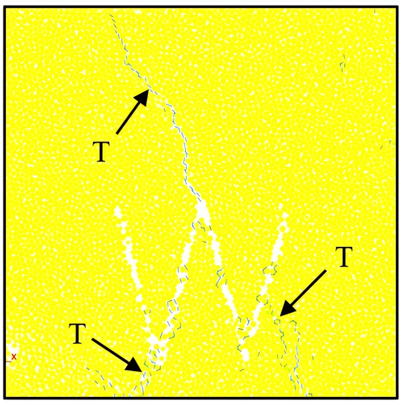
To study the uniaxial compression performance of rock masses with regular dentate discontinuities, uniaxial compression tests and Particle Flow Code (PFC) numerical simulation are conducted on cement mortar specimens, and the combined effects of dip angle γ, undulation angle β, and the number of undulating structures n of cracks on the compressive strength and crack propagation in the specimens are studied. The experimental and numerical simulation results showed that when n and β remain unchanged, the uniaxial compressive strength of the specimens peaks at a γ of 90°. When γ and β remain unchanged, the compressive strength of the specimens with regular dentate discontinuities decreases with an increase in n. When n and γ remain unchanged, the compressive strength of the rock mass specimens containing dentate discontinuity decreases with an increase in β. Almost all of the new cracks in the specimens initiate at the tip of the prefabricated cracks, and the failure characteristics of the specimens are mainly tensile fractures accompanied by a few shear fractures. When β and n remain unchanged, and γ is 45°–135°, the cracks in the dentate discontinuous rock mass propagate straight along the end of the prefabricated crack and finally vertically. In addition, when γ and n remain unchanged, the crack propagation of rock mass with β ≤ 60° is abundant. Moreover, when γ and β remain unchanged and n < 4, the crack propagation is abundant, and shear cracks are initiated at the edge of the specimens far from the prefabricated crack.
Share
RELATED ARTICLE
| eISSN: | 2300-3103 |
| ISSN: | 1230-2945 |

We process personal data collected when visiting the website. The function of obtaining information about users and their behavior is carried out by voluntarily entered information in forms and saving cookies in end devices. Data, including cookies, are used to provide services, improve the user experience and to analyze the traffic in accordance with the Privacy policy. Data are also collected and processed by Google Analytics tool (more).
You can change cookies settings in your browser. Restricted use of cookies in the browser configuration may affect some functionalities of the website.
You can change cookies settings in your browser. Restricted use of cookies in the browser configuration may affect some functionalities of the website.