


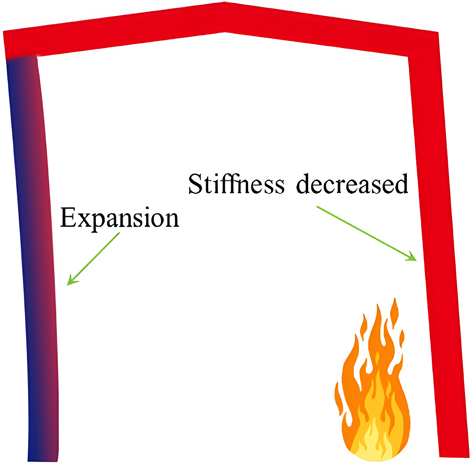
Thermal-mechanical responses of steel portal frame under varying fire scenes with diverse protective measures
1
Civil Works Department of Substation, China Energy Engineering Group Gansu Electric Power Design Institute Co., Ltd., China
2
College of Civil Engineering and Mechanics, Lanzhou University, China
3
Key Laboratory of Mechanics on Disaster and Environment in Western China, Ministry of Education of China, China
4
Institute of Highland Emerging Technology Research and Design, China Railway Construction Heavy Industry Corporation Limited, China
Submission date: 2024-11-14
Final revision date: 2025-01-17
Acceptance date: 2025-02-11
Publication date: 2026-06-14
Corresponding author
Archives of Civil Engineering 2026;72(2):467-483
KEYWORDS
TOPICS
ABSTRACT
This study investigates the thermal-mechanical responses of steel portal frame without fire pro-tection and with different fire protection strategies across three fire scenes. Temperature fields and heating curves were derived for the steel portal frame in three fire scenes using FDS simulations. Abaqus was employed to perform thermal-mechanical coupling simulations on the steel portal frame under eight conditions, both unprotected and protected with two types of fire protection. A comprehensive comparison and analysis of the simulation results yielded the following key conclusions: in all three fire scenes, the absence of fire protection and the implementation of two different fire protection measures lead to distinct failure modes in the steel portal frame, yet the lateral displacement response patterns remain consistent. Although fire protection strategies can delay the onset of displacement responses in the steel portal frame during fires, their effectiveness in reducing these responses is limited. Furthermore, fire-resistant boards alter the heat transfer path within the steel portal frame, increasing the temperature differential across the component sections and subsequently amplifying bending deformation. The findings provide valuable in-sights that enhance fire safety design for steel portal frame under diverse conditions.
| eISSN: | 2300-3103 |
| ISSN: | 1230-2945 |

We process personal data collected when visiting the website. The function of obtaining information about users and their behavior is carried out by voluntarily entered information in forms and saving cookies in end devices. Data, including cookies, are used to provide services, improve the user experience and to analyze the traffic in accordance with the Privacy policy. Data are also collected and processed by Google Analytics tool (more).
You can change cookies settings in your browser. Restricted use of cookies in the browser configuration may affect some functionalities of the website.
You can change cookies settings in your browser. Restricted use of cookies in the browser configuration may affect some functionalities of the website.