


Study on fracture patterns in moderately weathered granite due to blasting damage using the shock wave Coupled Eulerian-Lagrangian simulation method
1
Department of Scientific Research and Technical Services, Shandong Boshuo Geotechnical Engineering Design Consulting Co., Ltd., China
2
School of Civil Engineering, Shandong University, China
3
Railway company, PowerChina Municipal Construction Group Co., Ltd., China
These authors had equal contribution to this work
Submission date: 2024-07-14
Final revision date: 2024-09-24
Acceptance date: 2024-11-19
Publication date: 2026-03-04
Corresponding author
Mingyue Ma
Department of Scientific Research and Technical Services, Shandong Boshuo Geotechnical Engineering Design Consulting Co., Ltd., China
Department of Scientific Research and Technical Services, Shandong Boshuo Geotechnical Engineering Design Consulting Co., Ltd., China
Archives of Civil Engineering 2026;72(1):23-40
KEYWORDS
TOPICS
ABSTRACT
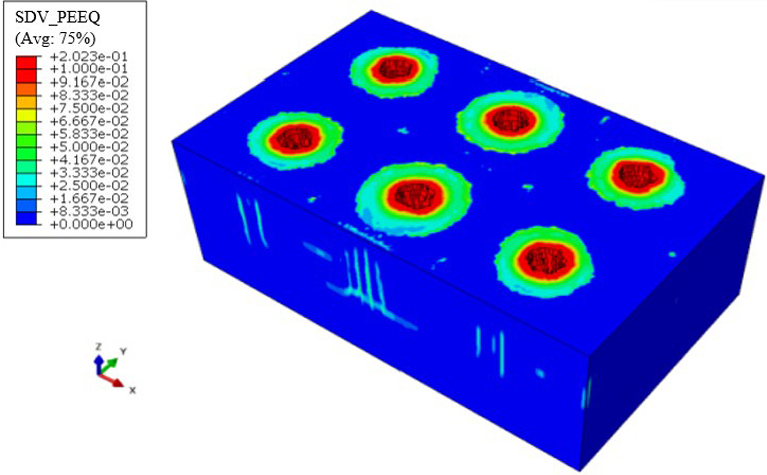
Depth gradients, which arise from variations in geostress at different strata, lead to rapid alterations in the internal stress state of rocks during blasting operations. These changes contribute to heterogeneities in rock strength and blast resistance, thereby presenting potential risks to engineering safety. To understand the damage and fracture patterns typically observed in granite blasting activities within underground engineering projects, we created a series of rectangular six-hole models using the advanced finite element software ABAQUS. By utilizing the Coupled Eulerian-Lagrangian (CEL) technique, the model distinguished between Eulerian parts, segmented into domains, and Lagrangian elements; the Eulerian domain was designated as air, while the Lagrangian section was characterized by TNT to mimic the shock wave propagation following detonation. This research scrutinizes the geostress conditions of granite across varying depth gradients, elucidates the extent and severity of granite impairment induced by blasting, and furnishes innovative viewpoints and methodologies for examining rock damage mechanisms in blasting engineering.
| eISSN: | 2300-3103 |
| ISSN: | 1230-2945 |

We process personal data collected when visiting the website. The function of obtaining information about users and their behavior is carried out by voluntarily entered information in forms and saving cookies in end devices. Data, including cookies, are used to provide services, improve the user experience and to analyze the traffic in accordance with the Privacy policy. Data are also collected and processed by Google Analytics tool (more).
You can change cookies settings in your browser. Restricted use of cookies in the browser configuration may affect some functionalities of the website.
You can change cookies settings in your browser. Restricted use of cookies in the browser configuration may affect some functionalities of the website.