


Research on the mechanism of graphene/rubber composite-modified asphalt based on molecular dynamics
1
CCCC-SHEC Engineering Testing Technology Co.,Ltd., China
2
Research and Development Center on Construction Technology of Long Bridge and Tunnel in Mountain Areas, CCCC, Xi'an 710199, China, CCCC Second Highway Engineering Bureau Co., Ltd, Xi'an 710065, China, China
Submission date: 2024-04-24
Final revision date: 2024-10-16
Acceptance date: 2024-11-05
Publication date: 2026-03-04
Corresponding author
Yu Lei
Research and Development Center on Construction Technology of Long Bridge and Tunnel in Mountain Areas, CCCC, Xi'an 710199, China, CCCC Second Highway Engineering Bureau Co., Ltd, Xi'an 710065, China, China
Research and Development Center on Construction Technology of Long Bridge and Tunnel in Mountain Areas, CCCC, Xi'an 710199, China, CCCC Second Highway Engineering Bureau Co., Ltd, Xi'an 710065, China, China
Archives of Civil Engineering 2026;72(1):169-184
KEYWORDS
TOPICS
ABSTRACT
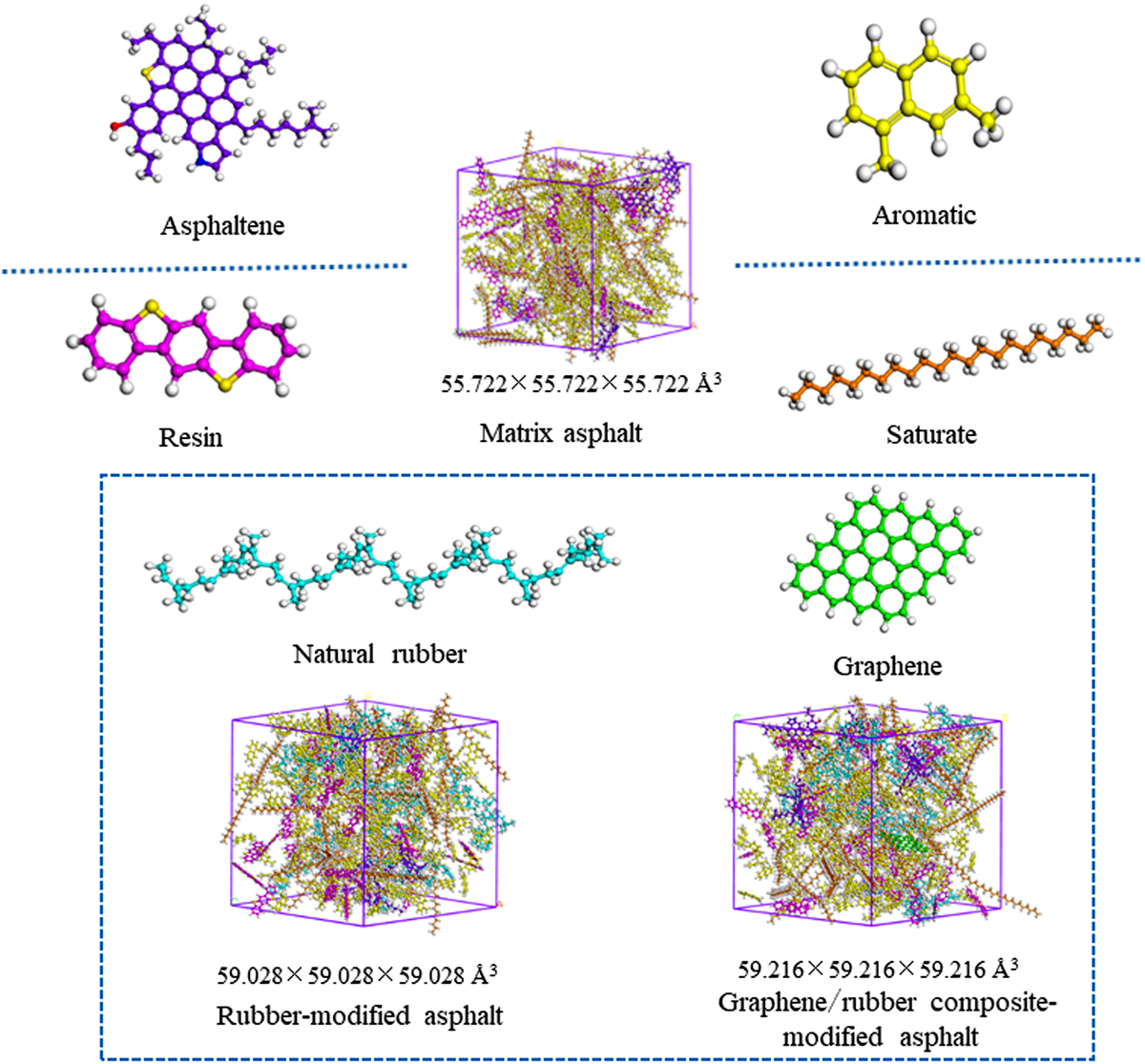
To study the modification mechanism of graphene/rubber composite-modified asphalt, the blending system of graphene, rubber, and asphalt was studied by molecular dynamics simulation. The molecular models of asphalt, rubber asphalt, and graphene/rubber composite-modified asphalt were constructed by molecular dynamics software. The intermolecular binding energy, radial distribution function, and mechanical properties of the three asphalt systems were studied. The results showed that the addition of graphene increased the binding energy between rubber and light components of asphalt, promoted the absorption of light components of rubber, improved the binding stability of rubber and resin, and improved the compatibility of rubber and asphalt. Graphene can weaken the agglomeration behavior of asphaltene and rubber, and promote light components to penetrate and fill the agglomeration space between asphaltene, which improves the overall stability of the asphaltene system. Graphene promoted the swelling development of rubber and made rubber form a stable spatial grid structure in the asphalt, thus contributing to the elastic modulus, bulk modulus, and shear modulus of graphene/rubber and asphalt blending system compared to the matrix asphalt has a greater enhancement.
| eISSN: | 2300-3103 |
| ISSN: | 1230-2945 |

We process personal data collected when visiting the website. The function of obtaining information about users and their behavior is carried out by voluntarily entered information in forms and saving cookies in end devices. Data, including cookies, are used to provide services, improve the user experience and to analyze the traffic in accordance with the Privacy policy. Data are also collected and processed by Google Analytics tool (more).
You can change cookies settings in your browser. Restricted use of cookies in the browser configuration may affect some functionalities of the website.
You can change cookies settings in your browser. Restricted use of cookies in the browser configuration may affect some functionalities of the website.