


Drainage of flat roofs in large–area facilities
1
Faculty of Civil and Environmental Engineering, West Pomeranian University of Technology, Poland
Submission date: 2024-08-21
Final revision date: 2024-12-03
Acceptance date: 2024-12-19
Publication date: 2026-03-04
Corresponding author
Krzysztof Wierzbicki
Faculty of Civil and Environmental Engineering, West Pomeranian University of Technology, Poland
Faculty of Civil and Environmental Engineering, West Pomeranian University of Technology, Poland
Archives of Civil Engineering 2026;72(1):55-69
KEYWORDS
TOPICS
ABSTRACT
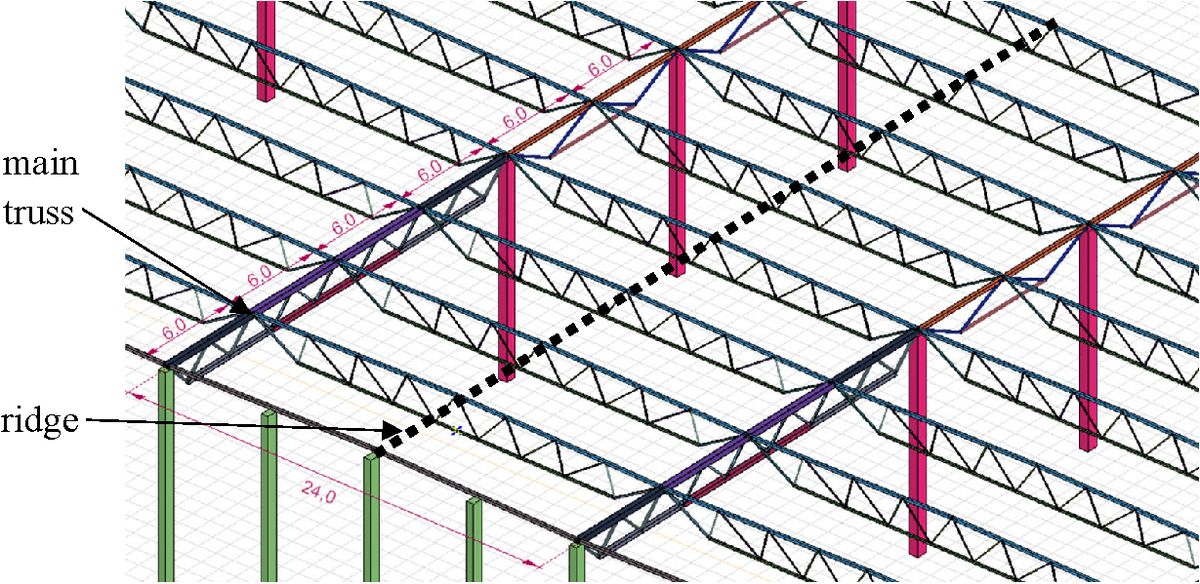
The large-area facilities are mostly based on the same materials and construction technologies. However, the larger the roof area, the more difficult it is to ensure the proper functioning of the emergency roof drainage system, which is most often implemented by means of emergency roof overflows. The problem is confirmed by at least several construction disasters caused by sudden and intense rainfall that have occurred in the last 5 years. The paper refers to the method of calculating the design rainfall intensity, as well as the definition of emergency roof drainage available in the literature. The effect of deflection of the structure from individual load cases, including standard loads, as well as from rainwater load in several variants, depending on the assumed snow load zone, is presented on the basis of a sample structure. The calculations show that structures with variable spans are particularly susceptible to the accumulation of rainwater. Due to the complexity of the phenomenon, the author does not provide a clear solution to the problem, but recommends the use of a double pipe emergency roof drainage system in such structures, rather than relying solely on roof overflows.
Share
RELATED ARTICLE
| eISSN: | 2300-3103 |
| ISSN: | 1230-2945 |

We process personal data collected when visiting the website. The function of obtaining information about users and their behavior is carried out by voluntarily entered information in forms and saving cookies in end devices. Data, including cookies, are used to provide services, improve the user experience and to analyze the traffic in accordance with the Privacy policy. Data are also collected and processed by Google Analytics tool (more).
You can change cookies settings in your browser. Restricted use of cookies in the browser configuration may affect some functionalities of the website.
You can change cookies settings in your browser. Restricted use of cookies in the browser configuration may affect some functionalities of the website.