


Axial dynamic impedance of soil and rod systems considering three-dimensional wave effects
1
China Road and Bridge Corporation, China
2
School of Transportation Engineering, Changsha University of Science and Technology, China
Submission date: 2024-09-24
Final revision date: 2024-11-25
Acceptance date: 2024-12-03
Publication date: 2026-03-04
Corresponding author
Shibin Kang
School of Transportation Engineering, Changsha University of Science and Technology, China
School of Transportation Engineering, Changsha University of Science and Technology, China
Archives of Civil Engineering 2026;72(1):551-563
KEYWORDS
TOPICS
ABSTRACT
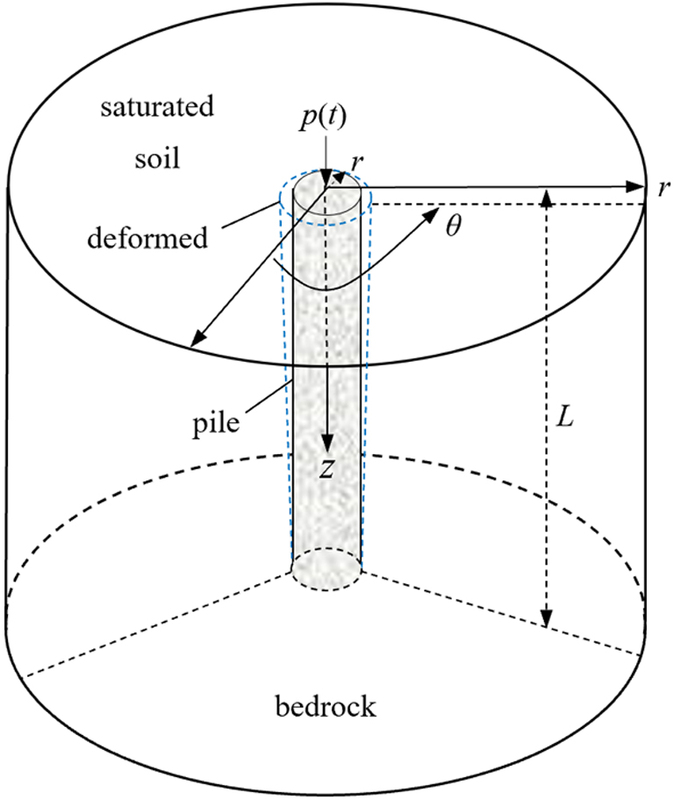
In order to reveal the influence of vertical and radial deformation and improve the accuracy of the calculation model of pile-soil dynamic interaction, an analytical solution of vertical dynamic impedance considering the three-dimensional wave influence of pile-soil is proposed. First, the Biot three-dimensional porous elastic medium governing equation is used to describe the dynamic behavior of saturated soil, and the pile is regarded as a three-dimensional rod with radial and vertical deformation, and its dynamic behavior is described by Navier motion equation. Then the motion equations of pile-soil are solved by the method of separation variables, and the dynamic impedance expression of pile is given. The accuracy of the proposed solution is verified by comparing with the FEM results and existing solutions. Finally, the three-dimensional solution is compared with the plane strain solution, the radial simplified solution and the one-dimensional solution. The results show that the radial deformation of the pile under the three-dimensional fluctuation effect has a significant effect on the dynamic impedance. Ignoring the radial deformation of pile will lead to overestimate the static stiffness of pile-soil system and underestimate the peak dynamic impedance of pile-soil system. When the excitation frequency f ≤5Hz, the utilization of the three-dimensional strict solution is more advantageous to obtain the dynamic impedance of the pile. In the range of excitation frequency, the radial deformation of single-phase soil can be ignored.
| eISSN: | 2300-3103 |
| ISSN: | 1230-2945 |

We process personal data collected when visiting the website. The function of obtaining information about users and their behavior is carried out by voluntarily entered information in forms and saving cookies in end devices. Data, including cookies, are used to provide services, improve the user experience and to analyze the traffic in accordance with the Privacy policy. Data are also collected and processed by Google Analytics tool (more).
You can change cookies settings in your browser. Restricted use of cookies in the browser configuration may affect some functionalities of the website.
You can change cookies settings in your browser. Restricted use of cookies in the browser configuration may affect some functionalities of the website.